Showing posts with label Research Methodology. Show all posts

Saturday, May 2, 2020

What is the need of Research in Business and Social Sciences.

Q. What is the need of Research in Business and Social Sciences.

Answer -


1) Social science research provides authentic information to the people that are scientifically proven so that end users can rely on it.

2) Social science research helps companies areas -
i) It helps healthcare sector to find cause of diseases 
ii) It helps in aviation industry to get info about travel patterns
iii) It helps service industry to understand customer satisfaction.

3) Business research is defined as systematic & objective process of generating, recording & analyzing data for aid in making business decisions.

4) It is designed as aid to managerial decision not substitute for it.

Define Concept, Construct, Proposition, Thesis, and Hypothesis.

Q. Define Concept, Construct, Proposition, Thesis, and Hypothesis.

Answer -


1) concept, is an idea that is generalization or agreed upon by people 

2) A concept is a Construct when it is destined with clarity & a method measure it in it inline with definition

3) Prepositions main purpose is to propose a link between two concept in situation where link can not be verified by experiment.

4) Thesis is an idea or theory that is expressed as a statement and is discussed in a logical way.

5) Hypothesis is just like preposition but hypothesis  must be testable & measurable.

How principle research method different from methodology

Q. How principle research method different from methodology

Answer -


1) Research method is defined as procedure Or technique undertake research Research methodology is a system of methods used scientifically or solving research problem.

2) Research method is nothing but behavior or tool , employed in selecting & building research technique.

3) Conversely, research methodology implies science of analyzing the manner in which can be employed in performance of experiment.

4) Research method conveys various investigation techniques unlike research methodology which consists of complete approach towards purpose attainment. 

State the objectives of research and illustrate the issues and problems in research.

Q. State the objectives of research and illustrate the issues and problems in research.

Answer -


Objectives of Research 

1. Potential value of a business research effort should exceed its estimated costs.
2. Decreased uncertainty for the problem under consideration
3. Increased likelihood of a correct decision
4. Improved business performance and resulting higher profits
5. Reduce research expenditures 
6. Reduce delay of business decision and possible disclosure of information to rivals
7. Avoid Possible erroneous research results


Issues and Problems in Research

1. No clear statement of research aims, which defines the research question.

2. No proper information sheet for participants, which sets out clearly what the research is about, what it will involve and consent is obtained in writing on a consent form prior to research beginning.

3. The methodology is inappropriate to the research question.

4. The research carried out in a biased fashion.

5. The research from the beginning, have inappropriate and insufficient resources in terms of people, time, transport, money etc. allocated to it.

6. The people conducting the research not trained in research and research methods

7. Those involved in designing, conducting, analysıng and supervising the research do not have a full understanding of the subject area.

8. No fresh eyes and ears of an outsider are involved, which may lead to bias

9. Information generated from the research not informed to the policy-making process where applicable.

Briefly describe various types of research.

Q. Briefly describe various types of research. 

Answer -


Basic Research


Basic research is called pure / theoretical / fundamental / conceptual research. Basic research includes original investigations for the advancement of knowledge that does not have specific objectives to answer problems of sponsoring agencies. When we want to expand the limits of knowledge, without directly involving the solution to any particular pragmatic problem, we would cut paste research. Fundamental research in mainly concerned with generalization and with the Formulation of a theory, Discovery and development of an organised set of scientific knowledge pet matter of fundamental research.


Applied Research

Applied research also called Action research, constitutes research activities on problems posed by sponsor agencies for the purpose of contributing to the solution of these problems. Applied research aims at finding a solution for immediate problem. The central aim is to discover a solution for an immediate practical problem. It is not concerned the development of any theory. When a decision must be made about a specific real-life problem, applied research endured.

Applied Research Examples Should Pizza Hut add Pav Bhaji to its menu?
Business research told Pizza Hut it should Should 

Maruti Suzuki offer parking sensor in A segment cars 
Research showed Maruti Suzuki it should not

Descriptive research 

It provides data about the population or universe being studied. But it can only describe the who, what, when, where and how" of a situation, not what caused it. Therefore, descriptive research is used when the objective is to provide a systematic description that is as factual and accurate as possible.

It provides the number of times something occurs, or frequency lends itself to statistical calculations such determining the average number of occurrences or central tendencies One of its major limitations is that it cannot help determine what causes a specific behavior, motivation or occurrence. In other words, it cannot establish a causal research relationship between variables.

The two most commonly types of descriptive research designs are Observation and Surveys.

Analytical research

Types of Research based according to the Research Methods used Depending upon the research method used for the investigation, it can be classified as.

(1) Survey Research Surveys ask respondents for information using verbal or written questioning. Respondents are a representative sample of people. Gathering information via survey is quick, inexpensive, efficient, accurate, flexible.

(2) Observation Research

"You see, but you do not observe." Sherlock Holmes. Scientific observations are always systematic. Physical actions, Verbal behavior, Expressive behavior, Spatial relations and locations, Temporal patterns, Verbal and pictorial records can be observed.

(3) Case Research Case studies are particularly useful in depicting a holistic portrayal of a client's experiences and results regarding a program. For example, to evaluate the effectiveness of a program's processes, including its strengths and weaknesses evaluators might develop cases studies on the program's successes and failures. 

(4) Empirical Research Empirical research in data-based research, coming up with conclusions which are capable of being verified by observation or experiment. The evidence gathered through experiments or empirical studies is considered to be the most powerful support for a given hypothesis.


Empirical research 

It is defined as any research where conclusions of the study is hero of the study is strictly drawn from concrete empirical evidence, and therefore verifiable evidence. This empirical evidence can be gathered using quantitative market research and qualitative market research methods

A research is being conducted to find out if listening to happy music while working may promote creativity? An experiment is conducted by using a music website survey on a set of audience who are exposed to happy music and another set who are not listening to music at all, and the subjects are the observed. The results derived from such a research will give empirical evidence if it does promote creativity or not.

Compare basic research and applied research.

Q. Compare basic research and applied research.

Ans -

Basic research
Applied Research
It is also called fundamental research.
It is also called action research.
Its aim is to advance knowledge.
Its aim is to find solution for a problem
It is concerned with theory formulation
It is not concerned with theory formulation
It is used to develop new concepts or reinterpret old ones
It is used to apply concept to real life problem


Explain types of research design?

Q. Explain types of research design?

Answer -

1. Exploratory Research

Exploratory studies tend toward loose structures with the objective of discovering future research tasks, goals to develop hypotheses or questions for further research. Exploratory research is used to identify the problem when you are unaware of what the problem is. Formal study begins where the exploration leaves off and begins with the hypothesis or research question. Goal is to test the hypothesis or answer the research question posed.

2. Descriptive Research 

Descriptive studies in at portraying accurately the characteristics of a particular group or situation. One may tam descriptive study about the work in factory, their age distribution, their community-wise distribution, their education level, the state of their physical health and so forth. Descriptive study may be concerned with the attitudes towards anything e.g. attitudes towards presidential form of Government, Right to strike, capital punishment etc.

3. Causal research 

If the research is concerned with finding out why then it is causal How one variable produces changes in another Causal research is appropriate to use when the purposes are to understand which variables are the cause and which variables are the effect, and to determine the nature of the functional relationship between the causal variables and the effect to be predicted.


Discuss important concepts related to research design.

Q. Discuss important concepts related to research design.

Ans -

Concepts Relating to Research Design There are various concepts relating to research design:

(a) Dependent and Independent Variables : A concept that can take on different quantitative values is called variables. If one variable depends upon other variable, it is termed as dependent variable and the variable that is Antecedent to the dependent variable is termed as independent variable.

(b) Extraneous Variables Independent variables that are not related to the purpose of the study but which may affect the dependent variables are termed as extraneous variables.

(c) Control: One important characteristics of a good research is to minimize the influence or effect of extraneous variables. The technical term 'control is used when we design the study minimizing the effect of extraneous variables.

(d) Confounded Relationship: Where the dependent variable is not free from the influence of extraneous variables the relationship between the dependent and independent variables, it said to be confounded by an extraneous Variables.

(e) Research Hypothesis When a prediction or a hypothesized relationship is to be verified by scientific methods, it in termed as a research hypothesis. It must contain at least one independent and one dependent variable.

(f) Experimental and Non-experimental Hypothesis Testing Research: When the purpose of a research is to test a research hypothesis, it is termed as 'hypothesis-testing research'. It may be of experimental design or of non experimental design.

(g) Experimental and Control Groups: In an experimental hypothesis-testing research, when a group is exposed to unusual condition, it is termed as control group' but when exposed to some novel or special condition, it is termed experimental group

(h) Treatment: Treatments are the different conditions under which experimental and control group are put. If we want to determine through an experiment the comparative impact of three varieties of fertilizers on yield of rice, in that can the three varieties of fertilizers will be treated as three treatments

“A systematic bias results from errors in the sampling procedures”. What do you mean by such a systematic bias? Describe the important causes responsible for such a bias.

Q. “A systematic bias results from errors in the sampling procedures”. What do you mean by such a systematic bias? Describe the important causes responsible for such a bias.

Answer:- 

1) Systematic error wherein results from sample differ Significantly in the results from entire population. It follows logic that if sample is not representative * entire population, the results from it will most likely differ from results taken from entire population


2) At best causes responsible for these errors can be detected I corrected


i) Inappropriate sampling frame-if sampling frame is inappropriate 

ii) Defective measuring device if meaning in error, it will result in systematic bias.
iii) Non-respondents if we are unable sample all individual initially included in the sample there may arise a systematic bias.
iv) Interdependence principle: Sometime we find individuals art, differently When kept under observation than what they do when kept in non obsessed Distortion
v) Natural bias - natural bias of respondent in Reporting of data is often the cause of a systematic bias in many enquiries.

Thursday, April 30, 2020

What are the differences between observation and interviewing as methods of data collection? Explain with two specific examples of situations where either observation or interviewing would be more appropriate. (MAY 19/ DEC 18) (10 Marks)


What are the differences between observation and interviewing as methods of data collection? Explain with two specific examples of situations where either observation or interviewing would be more appropriate. (MAY 19/ DEC 18) (10 Marks)


Ans -

Observation

Observation, as the name implies refers to situations where participants are observed from a safe distance and their activities are recorded minutely. It is a time consuming method of data collection as you may not get the desired conditions that are required for your research and you may have to wait till participants are in the situation you want them to be in. Classic examples of observation are wild life researchers who wait for the animals of birds to be in a natural habitat and behave in situations that they want to focus upon. As a method of data collection, observation has limitations but produces accurate results as participants are unaware of being closely inspected and behave naturally.

Interviewing

Interviewing is another great technique of data collection and it involves asking questions to get direct answers. These interviews could be either one to one, in the form of questionnaires, or the more recent form of asking opinions through internet. However, there are limitations of interviewing as participants may not come up with true or honest answers depending upon privacy level of the questions. Though they try to be honest, there is an element of lie in answers that can distort results of the project.

Explain characteristics of good hypothesis? Explain type 1 and type 2 errors? Level of significance? Variables in hypothesis? (MAY 18/ MAY 17) (10 Marks)


Explain characteristics of good hypothesis? Explain type 1 and type 2 errors? Level of significance? Variables in hypothesis? (MAY 18/ MAY 17) (10 Marks)


A hypothesis is a tentative statement about the relationship between two or more variables. It is a specific, testable prediction about what you expect to happen in a study. For example, a study designed to look at the relationship between sleep deprivation and test performance might have a hypothesis that states, "This study is designed to assess the hypothesis that sleep-deprived people will perform worse on a test than individuals who are not sleep-deprived."

Characteristics of good hypothesis
1    .    Clear, specific and limited in scope
2    .    Simply stated
3    .    Consistent with the relevant objectives of research
4    .    Capable of being tested and related to available techniques
5    .    States the relationship between variables, if the study is designed for that


Variables
1    .    A variable is a characteristic of interest that varies from one item to another and may take any one of a specified set of values or attributes.
2    .    It can be defined as any characteristic of an individual or a thing under study.
3    .    In other words, it means some characteristics of each number of the unit that is to be studied such as income, age, test score, land holding, etc.
4    .    Any item or characteristic which can be observed or measured and whose observation or measurement will be useful for the study can be regarded as a variable for the study.
5   .    A variable can take on different values for different individuals. Ex:  Heights of individuals:  Student #1: 5’ 5” Student #2: 5’ 7” Student #3:  5’ 2”


What is research methodology? Steps in scientific research process? Explain literature review? (MAY 19/ DEC 18)

What is research methodology? Steps in scientific research process? Explain literature review? (MAY 19/ DEC 18)


Ans -
Research methodology is the specific procedures or techniques used to identify, select, process, and analyse information about a topic. In a research paper, the methodology section allows the reader to critically evaluate a study’s overall validity and reliability.


Step One: Define research problem
There are two types of research problem,
1. Those that relate to states of nature
2. Those that find relationship between variables.
Essentially two steps are involved in define research problem,
1. Understanding the problem thoroughly
2. Rephrasing the same into meaningful terms


Step Two: Review of literature
Once the problem is define, a brief summary of it should be written down. It is compulsory for a research worker writing a thesis for a Ph.D. degree to write a synopsis of topic and submit it to necessary committee or the research board for approval.

Step Three: Formulate Hypothesis
Formulate hypothesis is tentative assumption made in order to draw out and test its logical or empirical consequences. Hypothesis should be very specific and limited to the piece of research in hand because it has to be tested.
The role of the hypothesis is to guide the researcher by delimiting the area of research and to keep him on the right track.

Step Four: Preparing the Research Design
The function of research design is to provide for the collection of relevant evidence with minimal expenditure of effort, time and money.
Research purpose may be grouped into four categories, viz., (1) Exploration, (2) Description, (3) Diagnosis, and (4) Experimentation.

Step Five: Data Collection
Primary data can be collected through following techniques:
1.    By Observation
2.    Through personal interview
3.    Through telephone interview
4.    By mailing of questionnaires
5.    Through Schedules

Step Six: Data Analysis
The analysis of data requires a number of closely related operations such as establishment of categories.
This stage mainly include:
1. Coding
2. Editing
3. Tabulation

Step Seven: Interpretation and Report Writing
Researcher has to prepare the report of what has been done by him.
Writing of report includes:
1. Preliminary pages
2. Main text
3. End matter


Review of Literature

    It consist of conducting extensive literature survey and gathering secondary data. The secondary data is the data and recorded by someone else prior to and for a purpose other than the current project. It is often historical and already assembled. Literature Review is essential preliminary task in order to acquaint yourself with the available body of knowledge in your area of interest. Literature review is integral part of entire research process and makes valuable contribution to every operational step. Reviewing literature can be time-consuming, daunting and frustrating. But is also rewarding. Its functions are:

1  Bring clarity and focus to your research problem
2  Improve your methodology
3  Broaden your knowledge
4  Contextualise your findings


Hypothesis Problems


Q1. A sample of 400 male students is found to have a mean height 67.47 inches. Can it be reasonably regarded as a sample from a large population with mean height 67.39 inches and standard deviation1.30 inches? Test at 5% level of significance.
Solution: Taking the null hypothesis that the mean height of the population is equal to 67.39 inches, we can write:
and the given information as X = 67.47”, σp = 1.30" , n = 400. Assuming the population to be normal, we can work out the test statistic z as under:

As Ha is two-sided in the given question, we shall be applying a two-tailed test for determining the
rejection regions at 5% level of significance which comes to as under, using normal curve area table:
R: | z | > 1.96

The observed value of z is 1.231 which is in the acceptance region since R : | z | > 1.96 and thus  H0 is accepted. We may conclude that the given sample (with mean height = 67.47") can be regarded


Q2 Suppose we are interested in a population of 20 industrial units of the same size, all of which are experiencing excessive labor problems. The past records show that the mean of the distribution of annual turnover is 320 employees, with a standard deviation of 75 employees. A sample of 5 of these industrial units is taken at random which gives a mean of annual turnover as 300 employees. Is the sample mean consistent with the population mean? Test at 5% level.

Solution: Taking the null hypothesis that the population mean is 320 employees, we can write:
                                                                
and the given information as under:
X = 300 employees, σp =75 employees
n = 5; N = 20
Assuming the population to be normal, we can work out the test statistic z as under:

As Ha is two-sided in the given question, we shall apply a two-tailed test for determining the
rejection regions at 5% level of significance which comes to as under, using normal curve area table:
R: | z | > 1.96
The observed value of z is –0.67 which is in the acceptance region since R: | z | > 1.96 and thus, H0 is accepted and we may conclude that the sample mean is consistent with population mean i.e., the population mean 320 is supported by sample results.

Q3 The mean of a certain production process is known to be 50 with a standard deviation of 2.5. The production manager may welcome any change is mean value towards higher side but would like to safeguard against decreasing values of mean. He takes a sample of 12 items that gives a mean value of 48.5. What inference should the manager take for the production process on the basis of sample results? Use 5 per cent level of significance for the purpose.


Solution: Taking the mean value of the population to be 50, we may write:


* Being a case of finite population.

and the given information as X = 48.5, σp = 2.5 and n = 12. Assuming the population to be normal, we can work out the test statistic z as under:


As Ha is one-sided in the given question, we shall determine the rejection region applying onetailedtest (in the left tail because Ha is of less than type) at 5 per cent level of significance and it
comes to as under, using normal curve area table:
R : z < – 1.645
The observed value of z is – 2.0784 which is in the rejection region and thus, H0 is rejected at 5 per cent level of significance. We can conclude that the production process is showing mean which is significantly less than the population mean and this calls for some corrective action concerning the said process.

Q4 The specimen of copper wires drawn form a large lot have the following breaking strength (in kg.weight):
578, 572, 570, 568, 572, 578, 570, 572, 596, 544

Test (using Student’s t-statistic) whether the mean breaking strength of the lot may be taken to be578 kg. weight (Test at 5 per cent level of significance). Verify the inference so drawn by using Sandler’s A-statistic as well.

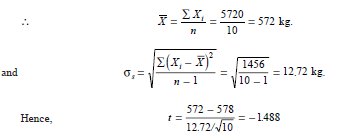
Solution: Taking the null hypothesis that the population mean is equal to hypothesized mean of 578 kg., we can write:


As the sample size is mall (since n = 10) and the population standard deviation is not known, we shall use t-test assuming normal population and shall work out the test statistic t as under:
To find X and ss we make the following computations:

Degree of freedom = (n – 1) = (10 – 1) = 9
As Ha is two-sided, we shall determine the rejection region applying two-tailed test at 5 per cent level of significance, and it comes to as under, using table of t-distribution* for 9 d.f.:
R : | t | > 2.262
As the observed value of t (i.e., – 1.488) is in the acceptance region, we accept H0 at 5 percent level and conclude that the mean breaking strength of copper wires lot may be taken as 578 kg weight.


Q5 Raju Restaurant near the railway station at Falna has been having average sales of 500 tea cups per day. Because of the development of bus stand nearby, it expects to increase its sales. During the first12 days after the start of the bus stand, the daily sales were as under:
550, 570, 490, 615, 505, 580, 570, 460, 600, 580, 530, 526
On the basis of this sample information, can one conclude that Raju Restaurant’s sales have increased? Use 5 per cent level of significance.

Solution: Taking the null hypothesis that sales average 500 tea cups per day and they have not increased unless proved, we can write:
As the sample size is small and the population standard deviation is not known, we shall use t-test assuming normal population and shall work out the test statistic t as:

Degree of freedom = n – 1 = 12 – 1 = 11


As Ha is one-sided, we shall determine the rejection region applying one-tailed test (in the right tail because Ha is of more than type) at 5 per cent level of significance and it comes to as under, using
table of t-distribution for 11 degrees of freedom:
R : t > 1.796
The observed value of t is 3.558 which is in the rejection region and thus H0 is rejected at 5 percent level of significance and we can conclude that the sample data indicate that Raju restaurant’s sales have increased.


Table to be referred for problems